
If Koyewin asks for another payment to release a balance, pause before sending it. A bonus credited on a casino page is not evidence that money can reach your wallet. Koyewin.com combines football imagery, enormous payout totals and promises of instant withdrawals, but those promises need more than a polished interface to support them.
A November 15, 2026 rendered scan of Koyewin captured its actual casino and a technical connection to a widely reused casino template. The review below checks that presentation against registration records and original sources. No account, deposit or withdrawal was tested.
Asked to pay before a Koyewin withdrawal?
Separate what you actually transferred from the balance the website displays. Promotional credit, a game result and a withdrawal request do not establish that a payment has been made to you. Ask what the new transfer is supposed to do and whether that condition was disclosed before the promotion.
The FBI’s warning about cryptocurrency investment schemes explains a related trap: fabricated gains followed by fees or taxes to obtain them. Paying the added charge does not release the money in those schemes. That warning describes a general fraud method; it is not a report of an identified Koyewin victim.
A written wagering requirement or identity check is different from an unexplained new payment demand. We did not establish a particular Koyewin customer’s withdrawal conditions. If a message asks you to fund verification, activation or the release of supposed winnings, preserve it before taking another step.
What Koyewin’s bonus page actually offers
Koyewin’s homepage and FAQ describe a quick email registration, followed by opening the Bonuses area and entering a promo code. The captured page offers original games and slots, advertises both cryptocurrency and bank deposits, and presents a VIP club and round-the-clock support for registered players.
The welcome promotion does not establish a specific cash amount in the material captured for this review. A code circulated in a video or private message may contain a different promise; retain the original promotion and its date instead of assuming every code has the same terms.
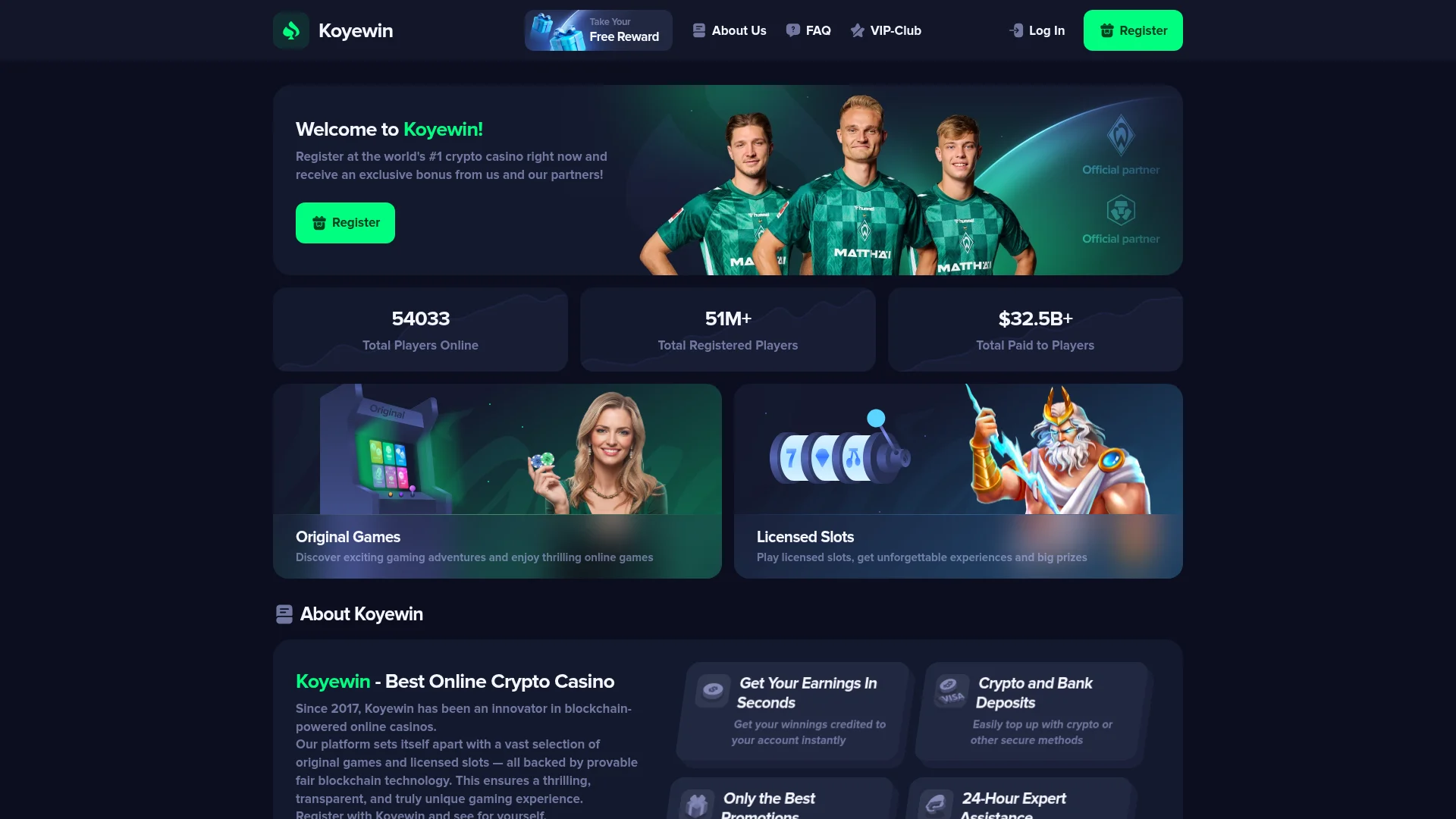
The interface puts the reward near familiar casino graphics and a registration button. That makes joining straightforward, but leaves the important payment question unanswered: which independently identifiable business is responsible for honoring the balance and the promotion’s actual withdrawal rules?
Football imagery is doing the work of an endorsement
The hero shows footballers in Werder Bremen shirts, the club crest and an Official partner label. Beneath it, the capture displays 51M+ registered players and $32.5B+ paid to players. Its online counter reads 54,033 at that moment.
Those numbers are statements made by the website, not a ledger of verified users or completed payments. A moving counter cannot tell a visitor whether an individual withdrawal will be honored. A club crest likewise needs corroboration beyond the casino page that displays it.
In its September 17, 2025 partnership announcement, Werder names NEO.bet as its continuing official betting partner. The announcement does not establish a Koyewin relationship. It also cannot, by itself, rule out every other commercial arrangement; the point is that this review did not independently verify the endorsement Koyewin presents.
There is no basis here to suggest that the pictured players participate in running this website or receiving its deposits.
The 2017 story does not explain the domain record
Koyewin describes itself as an established blockchain-casino business dating to 2017. The registration record for koyewin.com lists November 6, 2026, with Dynadot as registrar. That registration was nine days before this review’s capture.
A company’s age and a domain’s registration are different facts. An existing business can acquire a new address, so the date alone does not prove fraud. What is missing from the accessible material is a verified business history connecting Koyewin’s present domain and operator to its claimed earlier activity.
Dynadot’s name identifies the registration provider, not the business responsible for casino payments. The registry record does not solve that operator-identification problem.
A repeated template and dated security findings
The same football composition, 51M+ registration claim, $32.5B+ payout total and 2017 story appear in the separately captured Cachewin casino page. The changed brand is not evidence of a separate history for each set of counters.
Snyfer’s Gambler Panel Cluster record groups Koyewin through template-signature connections. This is an attributed technical association. It supports a finding that the presentation is reused; it does not identify one owner or establish what happened inside a particular player’s account.
The fresh Koyewin report records a VirusTotal aggregate of one malicious and two suspicious classifications out of 92. Those are different categories, not three confirmed malicious findings or a probability that a withdrawal will fail.
An older November 13 urlscan observation reached an access gate and states that it has no classification. Its submission tags are labels supplied with the scan, not a provider verdict. The November 15 rendered capture did reach the casino, so these records do not establish that Koyewin is offline.
Where are the license, audit and smart-contract evidence?
Koyewin’s FAQ presents licensing, decentralization, open-source software and independent smart-contract audits as reasons to trust it. The public text obtained for this review did not identify a verifiable audit report, contract address or source repository supporting those assertions.
Each claim calls for a different check. A gaming license should identify the responsible operator and cover the exact domain. A smart-contract claim needs an identifiable contract and network. An audit should name its author, date and scope, so a reader can compare what was examined with the service being offered.
During unauthenticated access, the licensing route returned to the homepage. Passive inspection also found an account requirement for that route. This prevented a public verification through that path; it does not establish that a particular license is genuine or false. We did not create an account to obtain further material.
The visible evidence therefore leaves Koyewin’s operator, claimed authorizations and promised technical safeguards unsubstantiated. A slot-provider label and an assurance about blockchain cannot supply those missing records.
Already sent money or shared account details?
Keep the facts that can be checked independently of the casino dashboard:
- The exact domain, promotion, promo code and sender’s account details.
- Original withdrawal requests, support messages and each demand for another payment.
- Payments actually sent, including receipts, dates, amounts and recipients.
- For cryptocurrency, the asset, network, receiving address and transaction hash.
The IC3 cryptocurrency reporting guidance explains the transaction details that help investigators follow a report. Keep the displayed balance separate from the amount you actually paid and any money received.
The FTC recommends contacting the payment provider promptly, reporting the fraudulent transaction and asking what reversal or refund options exist. Change compromised passwords, including reused ones, and enable two-factor authentication. Recovery is not guaranteed.
Be wary of a second offer to retrieve the money for an upfront charge. The FBI’s cryptocurrency-recovery warning describes that follow-on risk. Preserve those messages with the original records.
If you later compare another casino, check its operator, location eligibility and written bonus and withdrawal conditions first. The 1win offer on this page is an affiliate promotion, separate from these findings. Its bonus does not settle a Koyewin balance, and a new gambling deposit is not a recovery plan.